I have waxed poetic in many past posts on this project and my work in general, at the end of the day we must move on. The house belongs to the owner. Our job is done.
It did take a while.
We hit some snafus.
What work does not?
Here is what we did accomplish:
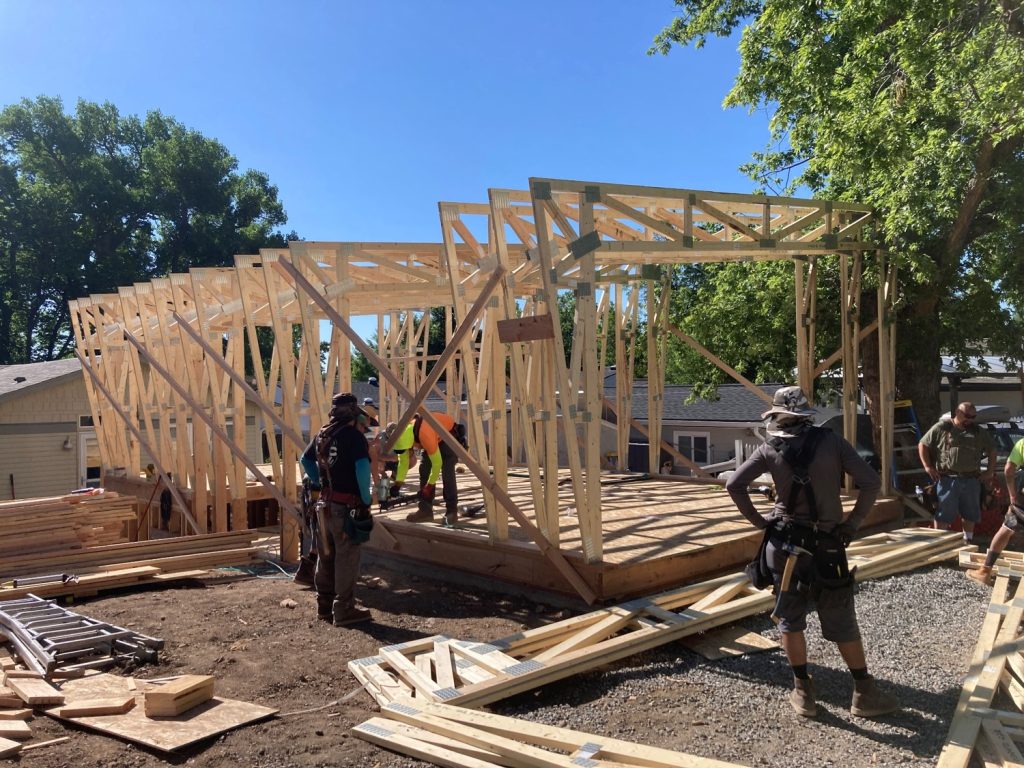
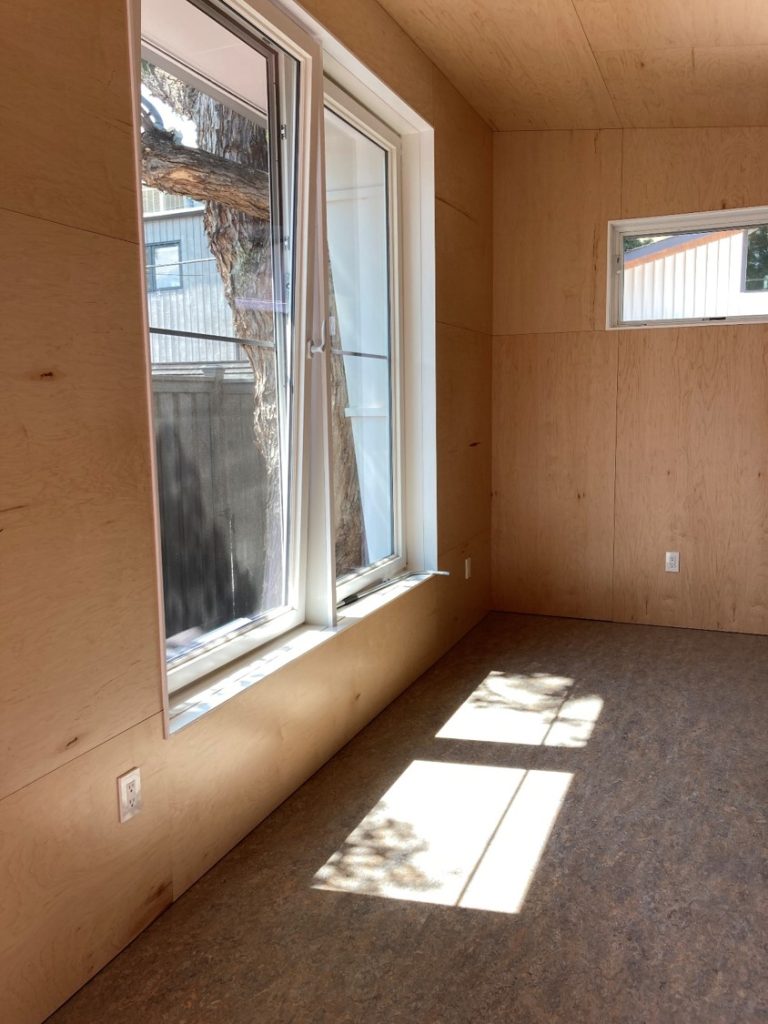
8 hours to frame. Versus 60+ to frame conventionally.
Custom shape. No upcharge.
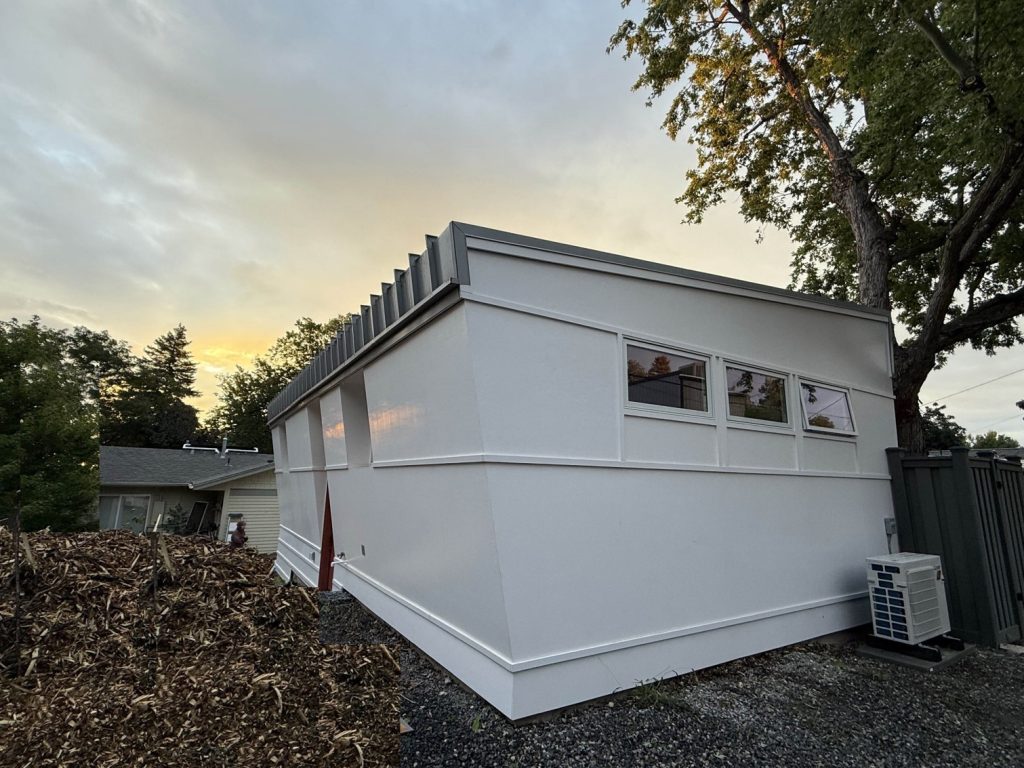
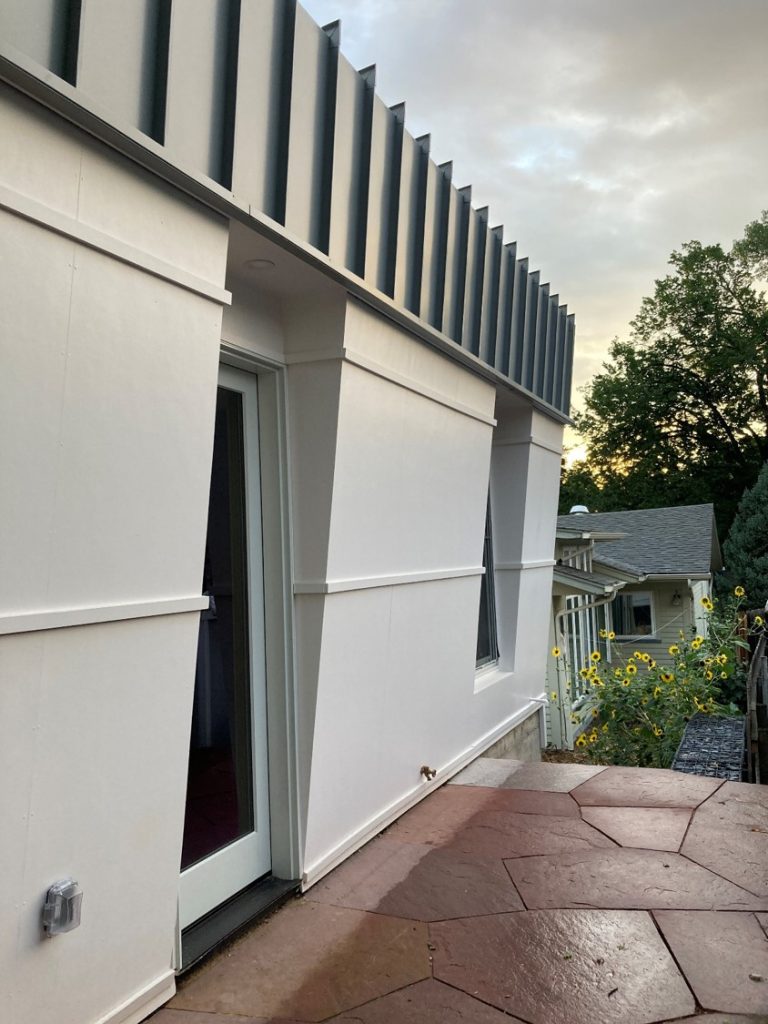
Sheds snow and rain. Without gutters.
Shades summer sun. No extra overhang.
No drywall.
Low embodied carbon.
Linoleum floor.
Low embodied carbon.
Air Change per Hour: 1.6 (code 3.0, Passive House 0.6)
HERS Index Score 46 (code sets a max of 60)
We also made a beautiful dwelling that should be a pleasure to live in, Watch our video: Brooks ADU
The Poche has long spoken about performance and intelligence. Now that it has achieved its Patent (USPTO #12227946), it is exposing its heart, aimed at people who want to be their best human.
Why would a startup with a patented building framing system, promoting economical, performance, and wellbeing advantages in a housing shortage market jump on a track for people who want to be their best humans? Aligning more with yoga, meditation, rock climbing, forest bathing, and the like? The housing market is real and the Poche offers a true solution to some of its hardest problems. So what’s with the Snug and its promoting space where you do nothing on the chance you might become everything?
This is the wall I have been staring at for a number of months as we standardize ADU plans for online purchase and entertain small house projects using Poche. Exciting times to be sure. But my heart keeps getting turned to face the Snug.
It’s an earth floor with a stone It’s a tree These are the superpowers
The Poche Snug is just the pinhole through which you get into a concentrated experience with nature. Not soluble. You either get it or you don’t.
I have no illusion that my stepping off the rail to propose a place for doing nothing is not deeply uncomfortable, but you see, evidence suggests that many of us suffer from something called place blindness, which is an inability to orient oneself in one’s surroundings due to a lack of direct experience. Here is when I begin to remember Slow Architecture. Places that aspire to create a direct experience. Places that by virtue of extraordinary intentionality concentrate an experience such that you vanish into pure presence. Slow Architecture historically dwells in the realm of the rich, the creatives, and the craftsperson. So the Snug with its modest scale and common materiality is plunking what was privileged into greater reach. Standardizing the wellbeing we gain through nature into a sliver of space we can put in your backyard or in a public garden or maybe even on a farm.
The idea that nature is of substantive benefit to us is well known…from ancient Chinese healers to Western writers such as Thoreau, the belief that connecting with the natural world improves wellbeing repeatedly appears throughout recorded human history. This is commonly experienced by folks of who get away to forests and beaches to recreate and decompress. Is it such a far reach to suggest that a small sliver of space intentionally connected to nature might become a commonly available space to re-create yourself? Do we create the world we dream by fixating on the material or do we create that world by becoming our best human?
As we struggle with affordability in housing construction, the Poche_Truss brings a modestly priced framing option to the table that significantly reduces material cost and installation time plus it sets up a super preforming building envelope. The challenge, however, to retain affordability throughout the entire construction, lands on minimizing complexity and, quite frankly, plucking housing out of the custom build business model that is emulating commercial GC construction instead of master builder construction. Master builder, that is how houses used to be built.
Here is how we are minimizing complexity: we are pulling the Poche_Truss projects increasingly into manufactured components (of which the Poche_Truss is one) and using flat-pack (such as IKEA kitchens) and off-the-shelf build out options (such as lumber yard interior panels). We are not, however, reducing complexity by creating generic boxes. That is the beauty of the Poche_Truss, we can custom shape space and form at no upcharge.
Plucking housing out of the current residential GC business model, turns out, comes right along with those same minimizing strategies, for you see, they all align with a more direct connection to the provider. Eliminating the middle man markup is like farm to table food. There are not many of us architects and industry professionals still practicing who worked in the master builder world. We want to align providers directly to the work.
As I have shared in previous posts, thinking beyond a GC model of building has been a learning curve. But not one I will leave as I find it. For you see, my work has always answered to the highest calling of my profession: create beauty. And beauty is inherently equalizing, because when you have the craft persons doing what they specialize in, everyone is a master. We are working hard to learn our lessons on this first build with the Poche_Truss framing system and to assemble our team of masters. With a goal of putting modest affordable houses smack into the crosshairs of a Heck Yea! project, we are preparing to help people find their joy.
Sometime in 2018 I was sitting in the sunroom at Red Wing, sketchbook in hand as I rolled a recurring thought around and around in my mind. The first sketches came out and as I considered what I was thinking I kept applying more and more criteria to it.. could this shape itself to regional environments…could this deal with roof drainage in an elegant manner …could this form itself to superior interior spaces.?.?.?
I recently read this: if aeroplanes were put into production in the manner of buildings, they would not fly. In my mind’s eye, architecture can soar. My thoughts as I continue to develop the Poche_Truss with the Brooks ADU under construction, fresh off the factory floor..
Boulder has done another ADU update that went live in September 2023, making ADUs more available. You might remember that I used to provide in-person and online ADU information presentations. Today, though, I thought that I would return to my ADU platform from a different perspective, so rather than giving you the code requirements, I am going to share with you what I do when making an ADU by bringing you into my studio, as it were.
inside the studio
1 Inside the Studio: The Interview
An ADU is a small house with all the same requirements of a big house, it needs to: fit into its site; be responsive to its local and regional conditions; accomplish the Owners’ goals – this means dreams, desires, and needs; and, not at all least or last, it needs to meet local codes. I start all my projects with an interview meeting to make sure the Owners’ agenda matches the work I am interested in. Yes, the work I am interested in. Post-tragedy, I no longer do any work that does not have the capacity to soar. Life is far too precious to squander on side tracks. I got sidetracked for a number of years. There were even projects where we had to break up. But even those that did not work out taught me something. What I learned was that I must always include this preface, even, and especially, when the project appears to be simple and uncomplicated: The architecture we make requires an authentic and rigorous approach from both the architect and the client; this agreement is entered into with this intent.
This statement sets the atmosphere. We are here to work in an intentional and meaningful manner and we are here to give it our full attention. The culture has shifted in the decades I have practiced architecture. Clients come with SKETCHUP and Internet design-surfing skills. Used to be they came with loads of pictures they had cut from magazines. We meet where they are at. But here is the thing, I have a 5-year professional Bachelor of Architecture degree including studies in Mexico City where I got to study and meet the famed international minimalist architect, Luis Barragan. Then I studied at the prestigious SCI Arc (Southern California Institute of Architecture), taking a semester in Europe with the illustrious founder, Ray Kappe, where we gained access to all the master architects’ studios in Europe as Ray’s reputation preceded us. SCI Arc granted me a Master of Architecture. I am a consummate learner, keeping current with the highest performing building systems and most intelligent building materials, and am constantly growing a highly skilled team. My building system, Poche_Truss, has a patent pending. However, the accomplishment that I am most in awe of remains the fact that I am a published poet with two lines of poetry that were published in UA’s monthly magazine in the 1970’s. I was unabashedly capable of exposing my true self.
The point of bringing all this up? Trust. If we are going to work together, we have to trust each other. Trust is something that seems to have gone out of fashion as everyone can second guess anyone including their medical doctor given the vast highway of Internet information. I am a fan of dialogue, after all it is YOUR house. But don’t forget the path that got me on this side of the table. Making Architecture is like slow food, it takes time to settle and have effect. At the end of the day, however, you will get ever so much more than a good building. At the interview, we arrive fully as we are.
I was on a long walk with a group recently and I found myself walking with a woman who had recently completed a house boat project where she and her husband now lived. When she asked me about my work, an audaciously clear answer came forth: I am interested in the magical mystical qualities of space, this is where the person living in the house gets to feel so alive.
Oooooh she sighed, I wish our architect had offered that. We got a perfectly fine house but… what you offer was never on the table…
The resonance between me and the client will reveal itself at the initial interview. Making the powerful kind of architecture that I am interested in is a true team effort. Not every person is ready for deep collaboration toward manifesting the goals. But if the interview reveals that possibility, I am prepared to begin.
2 Inside the studio: What are your Goals…?
I have a spreadsheet (of course I do, right??) whose purpose is to make space for the needs and desires of your goals to be programmed and their use to be dreamed. It is a matter of provoking the conversations to come through your mind and also your heart. We often risk articulating needs and desires through a lens of consumption: can my bathroom look like the one in Dwell? Or that I imagine while walking down the aisles at Crate and Barrel?
Instead of something like this: I need a shower, (never take a bath even though they always look so peacefully serene sitting next to a wall length of glass with daylight pouring through)… I need a lavatory and toilet…(a bidet? what is that?). Needs are usually established with fixtures or appliances and dimensions of space. In a bathroom this might look like a lavatory, shower, toilet and the space to use them, they are quantifiable. Once the needs are laid out, the conversation moves to consider desires such as: would you like a sauna or maybe a dressing area or how about a green wall of plants? These are things that require articulation as well and expand or build on the capacity of the needs but they go beyond the fundamentals.
Then we arrive at what makes life interesting – dreams: how do you want to feel in the space? How is the space going to influence your state of being? This is a bold notion to be sure, but think about how, as you go through your days, where walking across a park or riding your bike alongside traffic changes your emotion. If even for a moment. Our emotional body reacts. So consider what you want to experience as you groom as simply stretching into that emotional body experience. My go-to strategy to engage this begins with…in a perfect world…then your heart opens up and imagination flows as you propose that your bathroom is, in a garden!…maybe you step outdoors to shower?…and there is lots of daylight, even sunshine, alternately you might be thinking of it as a sanctuary as it might be the one place you can go to be alone. We inhabit our spaces uniquely and although the fixtures may be identical, not every bathroom has the same dream.
If we are working toward obtaining a project where the magical mystical qualities of space resound and you get to feel so alive, the dream needs to speak. This is not linear information, however, and giving it space with words on a spreadsheet requires enhancement through intuitive input so I often scribble in an image or maybe a line of poetry. The qualities of a dream arise from the intersection of physical space and the supple essences of light and shadow and color and senses, not quantifiable but poetic. I have been bringing information back from this intersection my entire career, decades in however, the process of getting something built wore down the translucency of this dimension and it took a tragedy to shake me back to this source. We all have this beautifully persistent tether to life, it might send a shiver up our spine or draw a wee smile into our cheek but conscious or not, our body connects.
I was considering a situation one day recently where I realized that I was tired of looking with my eyes and hearing with my ears and instead wondered: what does my heart see and hear? In that moment I looked out my window at the tall grasses from last years’ growth standing above the vinca patch and my eyes recognized that they should have been trimmed back months ago and I began feeling urgency to get that chore done. STOP, what if I asked my heart to look at those same grasses? Without changing anything else, here is what came forth: I now saw tall yellow stems whose fluffy heads were swaying without a care in the world as the frigid wind blew them to and fro. They were elegant and joyful and a smile came as I suddenly felt quite blessed to have this beauty in my winter yard. Minutes. These two scenes were minutes apart with only the means of engaging changing. I made a little move that shifted my relationship to the present moment from my thinking mind to my heart. This is how the information on those spreadsheets gets expanded, and as we consider how to engage the heart, something in your dream begins to inform value.
I hear you say a bathroom in a garden and my heart begins to see mottled light. Or you seek refuge and my heart begins to feel shelter. I cannot know these things before we have the Goals conversation for even if I have worked on dozens and dozens of bathrooms with the same fixtures, they are not your bathroom for they do not have your dream values.
How many self-help or feel good books have your read? Hearing about a non-linear process or even getting detailed instruction often times does not yield satisfying results. I had a daily yoga practice for almost 2 years before I found myself in that non-thinking state with my body easily folded completely over. I was quietly startled: this is yoga – union of body and mind! That very thing – an instantaneous and always remarkable moment of being aligned – is what happens when we step into the intersection of physical space and the subtle. I practice this as it is what keeps me passionately invested in this work. Not every architect knows how to bring back the clues from this intersection and I have found that inspiring as this process sounds, it also requires a willingness on your part to expose your story. Hence, trust. Not everyone is ready to do that. But if you are, I am prepared to take that journey with you.
3 Inside the studio: Get Pragmatically Poetic
Place. We are always somewhere, the question that arises is the one that asks if we are aware of where we are at? One does not make a building without having an idea of what will influence it. What breezes or views will inform, what sort of light will fall and cast shadow, what else is present, and most magnificently: what lifelines does the land offer?
When I enter into a dialogue with your site I am seeking information from two sources. One is totally pragmatic and analytical. Here is where the deal-breakers are fished out as it includes assessing the requirements of code along with physical conditions. Zoning code determines what you can build, where on the site, and to what density and intensity. If the site does not allow what you want to build or if the topography challenges where to build or the geography curtails the options, best to know sooner rather than later. And because I am a researcher, all of my code assessing is done with custom matrices that I have worked out to lead to simple site directives that locate where the building can go and articulating limiting factors such as coverage and height. A survey details topographic information as well as locating improvements such as structures, paths, and utilities. These collect the ‘what exists’ conditions and translate easily onto a site plan where I add solar pathways, views, and dominant wind patterns. At this point, I might begin to make a 3-d physical site model as well to help illustrate the site conditions. It is very cool to look over the site model where you can begin to feel the connections and disconnections.
This notion of being able to feel site conditions leads to the second type of site information that I have come to know as poetic lifelines. These are received when my heart (as opposed to my very competent thinking mind) expands to acknowledge information that arises from being present on the site. No agenda. I walk with open senses. This is where the powerful moves are sourced. In architecture we call them PARTI (a good match). In experience we note them as linking to profound presence. These present options for portals to the mystical/magical life-affirming interventions to enter and arise. If the site model is underway, I throw gestures onto it (I say ‘throw’ only because these are temporally attached with tape or glue gun or tacks) that embody this ethereal information. If the site model is not underway, the gesture model is made as a potential building. When I present these to the client, no words are required and very often a tear falls. These gestures hold lifeline truths. Difficult to talk about thus I make these powerful gesture models. Truth be told – if these gestural explorations do not occur, your project will not soar for the magical/mystical qualities of life would not get their portal. These are not added in after the fact, they are the wellspring for the design.
Ascribing poetic insight into a project is my architectural calling. For decades this was something I did but did not talk about. Too woo-woo. It wasn’t until I went to SCI Arc for my Masters that I encountered the gesture model. This gave me the tool but it wasn’t until I climbed Kilimanjaro, the highest mountain in Africa, in the Fall of 2001, that my resolve to make architecture in this manner was grounded. By 2001 I had been climbing mountain peaks since 1999, long enough to grow climbing legs and the stamina to keep going. When I stood on Uhuru Peak (the tallest point on Kilimanjaro at 19,341’ above sea level), I had an epiphany. On that peak, I felt an infinite line of humanity coming from and going far into the horizon, eternity came to mind where I was but a speck of dust. A voice inside me rose up and made a vow that I would do my part: I would make my contribution to the evolution of humanity, no matter how minuscule that might be. That vow has resided inside me, quietly watching as I veered my work around it until tragedy struck me clear.
As I meet my vow to humanity through architecture, it is the poetic portals that are captured in the gesture models that provoke presence where we get to touch life and expand our humanity. Not woo-woo at all, it turns out. In fact in our 21st century of complex chaos, an increasing number of us seek to reconnect to our inner peace and perhaps to a greater purpose. There is a beautiful reclamation going on where we seek minimalism and rewilding and biophilic connections not only with our living patterns, but with our physical environments. If you are one such person and you want your environment to be this, I am prepared to meet your site with my mind and my heart.
4 Inside the studio: Heck Yea!
I recently declared the business side of Studio Points to be a failure. When I dared declare this out loud, a weight sailed off my shoulders and furthermore, I was cool as that proverbial chilled cucumber. This odd emotionless state where one should think emotion would run rampant reminded me of the time when I was 7 or 8 and my family was driving all night through northern Mexico headed for the Arizona border and our relatives in Tucson for Christmas. We stopped for gas at a PEMEX station with blindingly white fluorescent light where my six siblings and I had raced to the restrooms. I was last and – turned out – left behind. I vividly remember coming out of that restroom to an empty blindly white station and calmly reaching down to tie the laces on my saddle shoes, I was very proud of those shoes. My thoughts turned to: I guess I will have to get a job… as I stared into the darkness beyond. Not a shred of emotion. I can feel that moment in this day. I guess I will have to grow up.
To whom am I speaking when I declare this failure as I sit at the tiny island desk with my computer that is, since COVID, the digital home of my studio? Of the many fall outs from my tragedy, no place to hide has been the biggest. In that valley of death, despair, and desperate sadness, all of my cloaks fell off. Not willingly, they were gouged and ripped and torn away as I thrashed about in that dark state. Sounds violent. In grief, however, I was not inhabiting my body much of the time so this internal violence was irrelevant. I think I am speaking to my soul. Or maybe a gigantic everywhere SOUL, my source.
I declared Studio Points’ business a failure night before last and the next morning meditation found Soul Design Group standing before me. My son was a designer. In high school he established himself as Soul Design Group and remained so until the end. I visited the site today and remembered the energy of his work.
Admitting to my soul that my business has been a failure turned it right back on me for, in some thinking, it was I who had decided that Studio Points should have returned monetary success even though that had never been its purpose. Its purpose was always (perplexing those around me) to follow the breadcrumbs of intuition, to find the sources of extraordinary exchanges…the little threads of poetry. Studio Points did not fail at that at all, which makes the pursuit of those gifts at the intersection of physical space and the subtle so very poignantly relevant. The thing, though, although intuitive insight is beyond question, is that it is also most easily displaced by thinking. Making money was the conclusion that my mind came to as my outer world fell utterly apart after Soren. The other strong base of my life had already torn away. My soul-mate and husband moved to Southern Colorado in an agreed separation to allow us to each find ourselves again. Then, in 2020 just as COVID shut down the world, he was diagnosed with a brain tumor. He would choose to live out this phase of his life without me. I had to let go, this was all mixed in with Soren’s final year. My world became flat and monochromatic. Money began to look like a fine partner. If only…
Following money is no way to make the sort of architecture that I believe in. Never was, never will be. And just to make sure, quite matter-of-factly, the mystical magical exchanges in the work I am interested in making fell off the table in those recent projects. Those vital exchanges were never properly woven through the work at the time. Wrong projects for me. They landed in my studio with a: sure, I will do this, rather than a: heck yea! The eroding of my source had occurred across a decade, which is actually a common occurrence as we move into a busy life or a challenge that turns our head away from anything except surviving. Hard stuff. But hard stuff also lays a path back. My son’s death and my husband’s estrangement left nothing else to erode and, left with my architectural training, I became determined to find my way back to what had always deeply connected me to life. It was in the making of the Impossible Conversation video that my lifelines began to show up. I was following heck yea!
As my story sits on these pages, it takes on the power of those gesture models. It is outside of my thinking mind and begins to reveal an amazing truth: I have nothing else to lose and what remains is my steadfast core. Eureka! This is how minimalism comes about. We see it as a design aesthetic in Zen or – in my case – I have that personal reference in my experience of Barragan’s work where a space of slowly flooding water consoles the soul. Stopping time, expanding awareness. This is the work that draws me in, heck yea! We never know where a project will take us. Refining it to a core is very much the essence of design. I dare say this is the very essence of living, work we all specialize in.
5 Inside the studio: A Project as Small as a Window
I claim to specialize in small houses, ADUs, and backyard studios. I am even currently developing a single user 80 square foot snug. But no matter how much I reduce and compress the size, one glaring piece remains, intact yet largely unnamed.
I think it was sometime in the early 90’s when I would insert into conversation the possibility that I would be so bold as to do a project as small as a window. An image would form in my mind as I’d wait for a reaction but there were none of note. Except inside me, I was seriously curious about this proclamation: I will do a project as small as a window! What in the world was I seeing that made that a reasonable, if albeit unconventional, statement? Aside from the fact that it felt really good to imagine a project that was essentially a window?
Over the decades I worked on multi-person housing with monastery projects, then moved on to cleverly bespoke houses (I say clever only because as I look back – dang I was fearless! I’d tip trusses upside down to let a swath of light in right at the top of the wall; I’d make glass boxes on roofs; I’d have entire two story walls sheathed in Masonite and painted in a mottle of a handful of colors to catch a particular light quality; I removed a path of flooring in an attic bedroom and sheathed it top and bottom with thick double layers of sanded plexiglass to let light and dancing shadows from the giant tree just beyond the roof window fall into the hallway below. I was fearless and had no idea that I was fearless, that’s what made it clever). Those awesome single family houses, however, just got bigger and bigger until right in the midst of working with a powerful ‘make my career’ developer, I broke.
I remember the feeling. I had wrestled with the increasing size of that house for months yet it grew bigger and bigger and I found myself thinking that I had no tools to know how to make architecture whose only goal was big. I paced the studio and stared at the drawings and models, the only piece making any sense was the Ronald tower. On the lowest level the tower had a dirt floor and held a wine cellar, from there a circling stair made its way up two stories to a glass perch that would be Ronald’s room holding only a small desk in a glass spire surrounded by tall trees. A boy’s tree house, a sentinel’s lookout, a perch where the world was his oyster. It was not a big piece at all and it’s the one piece he did not ask for, but once seen, it was undeniable. Ever so clever. That tower kept me going far longer than I should have. But eventually I did break. Bigger for bigger’s sake was just untenable. This client was paying me handsomely but this particularly abundant project just confirmed that my work was not about money.
It happens slowly, floating away from source, so very slowly, that even as I continued to work I didn’t realize I had floated so far. I love my work. I love the clever bits I have made. But I became seriously lost and it has taken two decades and tragedy for me to be able to touch my base again. We do not realize how a clients’ unseen values can undermine the architecture. I was so very hesitant to declare the big and bigger project beyond my capacity, until I broke. It was not an analytical break, it is not in architecture’s business interest to break up with a client. But this was too much and conventional practice provided no guidance. It was my heart breaking. At work, no less. I would find out that the work I choose to do is undeniably heart based. But it wasn’t until tragedy struck me that I would stand smack dab in the center of that bifurcated road asking myself if I was capable of bringing my heart publicly into my work. Clearly it had informed all those beautifully clever moves in my past projects, but I never spoke about them or worried over them. They just were so and, so much gratitude for the clients, they did not question. The world changed and clients and their values showed up in postures I did not recognize. Without a formal setting to anchor the heart centered work, I became lost. Standing at that bifurcated road asking myself if I was capable of bringing my heart publicly into my work, I used my training to flesh out what I had been unable to see. Making the Impossible Conversation video gave me the gesture that answered: heck yea!, I am ready to go public. What option do I have as no matter how much I shrank and compressed the apparent scale of my work in an attempt to see less of my sorry state (!), there remained that one bit that only become more. It held all the portent of the architecture I am here to make.
For years I had a dream where I held a remarkable tiny stone. What made it remarkable is that although it was minuscule, it had an illogically massive density, a beyond comprehension sort of weight. All contained within the tiny little piece sitting between my forefinger and thumb. This contradiction would churn in my mind as the sensation traveled through my body: so small yet fathomlessly dense! That sensation left its imprint inside my body. Most people aspire for bigger and bigger projects as they peer into the future of their work, yet I have intentionally compressed my work into smaller and smaller containers.
To see the world in a grain of sandand a heaven in a wildflower, hold infinity in the palm of your hand…William Blake
Unless you place a camera on a budding flower, it is very likely that you will not see it unfurl. Time lapse images expose clues which, in my case, began with my 30-something self proclaiming that I’d take on a project as small as a window; to all the clever moves in the projects I am so deeply grateful for; to that lucid vow at the top of Kilimanjaro; and went on through the valley of death and all its sticky parts. Those clues were pointing to the bit that would became more with each compression. It was the clever aperture that did not show up in any clients’ goal list but that nonetheless showed up with full authority. The apertures across the projects hold one common ground: they all make a connection to something greater than their own space. I ascertained in the decade that I taught design studio at CU’s College of Architecture ENVD program, that you cannot insert meaning after the fact. You need to have process that allows it to enter and find root. Regardless of how much I reduced and compressed the scale of my work, the undeniable held its ground. Anchored by the thick intentional base that I have set through that initial interview, followed by the goals process of illuminating the dream, and the site exploration that gifts the project its gestures, the one undeniable piece provoking connection to life has publicly made its way onto my table. There is nothing small about a window.
6 Still inside the studio…
I was going to be a poet. That was me during high school and even into the early architecture school years. A poet..! Might have been more fitting to this journey I am taking to declare my work. Architects just get to work. Perhaps falling in love with material and gaining competency at putting a building together well and practicing inspired form-making. Accumulating experience and seeing their pattern repeating is how most architecture careers go. The challenge therein seems to be that my path has been a bit obtuse.
“Being different is powerful when you understand it must come from a truth you can uniquely bring to life.” My mom had told me that I was always different as a child. It didn’t sound like a superpower. But this quote from the DO Lectures in Wales gets me thinking about the challenge before me. I always thought that my career unfolded differently than my peers because I had missed some vital truth about making a business out of my work. This didn’t trouble me, per say, but it was a fact persistently in my side-view mirror. As my truth poured out after I lost…well, everyone, and I had no place to hide the fact that my architecture career did not look like those around me, perhaps the truth of my difference must come to light. I make the work that matters when it is deeply invested in the subtle. This is where it seems that my architectural path diverges from the pack. Here is the brilliance of truth though, it is always a paradox because the truth of my difference is that I am not different at all. It’s just that I have made the vast majority of the trappings of making architecture irrelevant. I have reduced the work to an essence that has little to do with quantifiable accumulations. Most architecture chases the physical, so, stripped down, my work might look different but this is what architecture is supposed to do. Reveal our connection to life, not to stuff.
When I lost my son and husband my world flattened and I experienced a dissolving as buckets of irrelevance poured away, allowing the subtle to embrace me. This is minimalism. I love my work. I love the clever bits. I love the model making. I love investing your dreams with portent. I love touching life through space and form and material and color. I LOVE being an architect. And my tragedies have cleared away any short-circuiting these facts.
So what’s the problem…can you find me? Because in my heart I know that it is time for the architecture that is sourced in the subtle and whose goal is to help us evolve, to step up. We do this by releasing the buckets of irrelevance that have driven over-consuming on every scale, pushing us outward rather than to the peace and stillness of inward. This path is different. In today’s world where one can get whatever one wants by a google search, the thing I am talking about would not show up on a search platform. Because it does not fit an algorithm. It is attached to the heart. Not linear or programmable. Like that earlier story about the woman on the walk who, upon hearing what I do in my work, took a faraway look and sighed, the thing I was talking about was never on the table with her recent house project. And if you do not know to ask for it, how do you find it? I recently discovered the declutter queen, Marie Kondo, (!, right?…on this different architectural path that begins with sorting irrelevance!) who teaches about asking your things if they spark joy in you as you determine whether to keep them or not. This surprisingly simple exchange has outsized power to affect a remarkable outcome. Does your architect or builder spark joy in you as you consider them for your project, does your project spark a Heck Yea! in me? That is how we find each other. We get there by releasing buckets of irrelevance. Which is why I specialize in small, smaller, and snug houses. It won’t be the vast amount of space or stuff inside the space that will tune you into life, it will be if your heart is awakened. Not many architects put this on the table: heart-centric architecture making apertures that go beyond physical space. There – it is said and it is fully charged and ready to go.
On December 30, 2021 I was leaving my doctor’s office at around 11:00. We noticed plumes of black smoke off to the south but went about our business in Boulder, stopping to eat at DOT’S before noting there was now LOTS of black smoke to the east. As we ran our errands, the staff at Walgreens were all on their phones with reports of road closures, power lines down, and instructions to shut the shop doors. The winds were tearing up the sky and whipping the car doors from our grip. Eyebrows raised, we went off to McGuckin’s and found it…closed? By 4:15 that hospital and its campus had been evacuated by what would turn into the catastrophic Marshall Fire where 1,084 houses were destroyed, forever altering the lives of those households.
8 months to the day later, the Town of Superior has issued 32 building permits for 3.6% of their 380 houses counted as being destroyed or with major damage. Folks want to get back to their normal.
Here’s what I wonder: after COVID and the Marshall Fire and under the influence of climate change restructuring the planet’s ecology, is that even probable?
I jumped in with the rebuilding effort of Superior for two reasons:
1. Within months of the fire, Superior amended its zoning policy to allow ADUs to be built before the main house.
2. Xcel, the energy supplier for the area, was offering a significant rebate of $37,500 to rebuild to PassivHaus standards.
ADUs and PassivHaus will NOT give people back their normal. Instead, they set a whole new bar: better living, better building.
Better living: our ADUs are built with the Poche_Truss where the building form, both inside and out, are custom shaped to the contextual environment and desired experience, without a custom build upcharge. Living in an intelligent (think responsive) small (think less stuff) house will realign your living to what matters most – being present.
Better building: our ADUs are built to PassivHaus standards bringing superior thermal, audio, and environmental comfort; and by using the Poche_Truss building system, our ADUs achieve passive survivability in these times of uncertain utility reliability and climate upheaval.
Moving forward. Not going back. Good design is like that.
Old growth redwoods outside of Crescent City CA, September 2021 (c)mlRobles
I have lived in Boulder since 1978 when I stopped on my way to Seattle from Tucson. I was a bright-eyed romanticist architecture graduate from the University of Arizona College of Architecture. Boulder struck me as so very very obviously beautiful, it hurt my eyes after the austere and sublime desert of Arizona. I was annoyed at all this beauty just oozing out everywhere I looked. But the city was so sweet and kind and accessible after the endless sprawl of Tucson, so I stayed, and stayed, and stayed.
I began to see beyond the obvious beauty of this natural setting and to love the seasons that transformed verdant landscapes into wet yellow clumps and to find streaks of ochre and lime green in the dirt and rocks and to engage the fog in hide and seek and allow the clouds that sweep over the foothills to blow my mind.
As the decades passed it was the city that began to hurt my eyes and ears. I would travel away and come back to a renewed letdown at the small-mindedness that was driving change in my city. What had been a remarkable Frank Shorter running through the city became every wannabe in spandex flashing through the neighborhoods. What had been neighborhoods of modest bungalows and ranch houses with big mature trees became neighborhoods of houses and trees scraped clean to make way for shiny super-sized and paved mcmansions to satisfy the appetites of the increasing influx of people wanting something from our city. As though that early sweet kind accessible city that nurtured the likes of Frank Shorter and Mo Siegel could be had with a bulldozer!
I have sat in stillness these recent years as bulldozers’ dust made my eyes tear and the loudness of STUFF moving in and around made me deaf. The quieter I got, the less the influx mattered. The raw greed, massive consumption, and little regard for what was already here became innocuous. I stopped fighting and surrendered. And then something remarkable happened. The simple joy of being began to rise. And the questions that pressed my mind had little to do with annoyance at the state of my city, rather they became instances of insight that touched my heart. You can read about this evolution in my previous posts, today, we feast at the center of this insight: architecture for the joy of being!
If this sounds dubious to you, stop and look around. Take a few breaths. What do you feel? Then take another breath and see what you feel, then another and another until you find you aren’t looking around but rather looking within. And all you feel is space. This is the point of architecture: to articulate space such that its inhabitants can find their way to inner space. The noise stops. Joy rises. It is the highest calling of my profession.
I return to being a bright-eyed romanticist but I am also a mature architect and I know that not everyone is ready to be still and to find their way to the space within. The dazzle of stuff remains strong. Architecture for the joy of being, however, is here, for those who are ready.
Our first wee house in a backyard is done! #14 under Boulder’s revised ADU regulations. Its total cost, excluding land, in 2019-2020 was $190,600, at 540sf that translates to $353/sf.
Our second wee house in a backyard is under design. This one is substantially different. For one, lumber costs have more than doubled in cost and preliminary cost came in at almost $500/sf. A 41% overall increase! Plus – Boulder adopted the IECC’s 2018 energy conservation standards. But wait, there is more – COVID-19 happened and the city approval process is spiraling in excess and redundancy. Yikes. I, however, remain undeterred in building ADUs to change the way we make small houses and use our urban land. ADUforMe and Studio Points are making their way through all of this. We bring a solution to the table. Coming soon…the Poche_Truss!
I had a family reunion in Austin this past weekend. And you know how reunions go, you are so involved with enjoying the get together you push other things to the back of your mind. Like visiting the loo.
I, however, had a loo – front and center in my mind.
Lady Bird Loo, Austin Texas, Mell Lawrence Architects, AustinBuildings need to work amazingly well. Ours do. They reflect a deep sense of place and life pattern. Mell Lawrence Architects, Austin
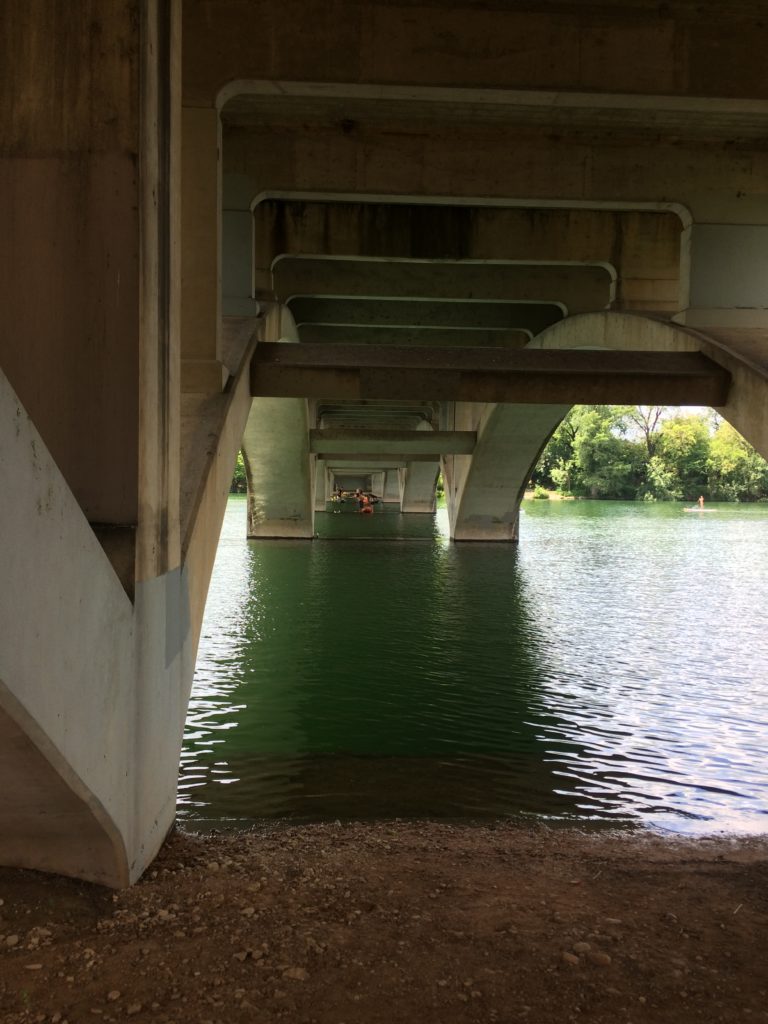
It was late morning on a hot and humid July day, typical for Austin. The Colorado River looked serene in its placid state of pale green and blue water. A cooling breeze seemed to drop the temperature to bearable as we walked the gravel trail along its bank.
Two awkward looking rusted steel structures came into view. I instantly recognized them from their published photos. They looked more shadow than structure as the tall steel sheets rose directly from the ground.
When you are on an architectural pilgrimage, no matter how humble, attention is moreso. I walked around the structures, peeking into the narrow gap between the steel panels and the concrete end wall, noting the carefully detailed clips that held the steel panels to the frame. The panels were already covered in rust, the intended end game of Corten steel that allows the natural salt and humidity to corrode its surface to a point of patina before further corrosion is inherently stopped. This rust felt almost dangerous as I carefully inspected the corrosion flakes.
I ran my hand along the board formed concrete end walls, feeling the wood grain and the concrete bits that leaked through, forming thin rough rows across the wall.
As I continued to walk around the buildings, sensing the tall and folding walls, I eventually realized that they were locked for maintenance. Actually, that had not in the least diminished my experience. The buildings were quite available as simple structures along a trail. Belonging to the site regardless of their use. Good design is like that.




 Old growth redwoods outside of Crescent City CA, September 2021 (c)mlRobles